palGenericBody Class Reference
#include <palBodies.h>
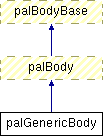
Public Member Functions | |
| virtual void | Init (palMatrix4x4 &pos) |
| virtual void | SetDynamicsType (palDynamicsType dynType) |
| virtual void | SetMass (Float mass) |
| virtual void | SetInertia (Float Ixx, Float Iyy, Float Izz) |
| virtual void | ConnectGeometry (palGeometry *pGeom) |
| virtual const PAL_VECTOR < palGeometry * > & | GetGeometries () |
| virtual unsigned int | GetNumGeometries () |
| virtual void | RemoveGeometry (palGeometry *pGeom) |
Detailed Description
A generic rigid body, for representing a body (static, kinematic, or dynamic) composed of multiple geometries. This is a rigid body that supports every possible representation. It has similar functionality to a compound body except that additionally: 1. The body type can be changed between static, kinematic and dynamic. 2. The mass properties of the body can be adjusted at any point in the simulation 3. Geometries can be added and removed at any time (ie: Finialize() is not required)The constructed body is dynamic by default.
This body is only supported by the most advanced physics engines. (ie: very few) If you are seeking maximum portability avoid using the generic body.
Member Function Documentation
| void palGenericBody::ConnectGeometry | ( | palGeometry * | pGeom | ) | [virtual] |
Connects a constructed geometry to the body (This is similar to the compound body's palCompoundBodyBase::AddGeometry() call, however no finalize is required)
| const PAL_VECTOR< palGeometry * > & palGenericBody::GetGeometries | ( | ) | [virtual] |
Returns the geometries connected to the body
| unsigned int palGenericBody::GetNumGeometries | ( | ) | [virtual] |
Returns the number of geometries connected to the body
| void palGenericBody::Init | ( | palMatrix4x4 & | pos | ) | [virtual] |
Initializes the body
| void palGenericBody::RemoveGeometry | ( | palGeometry * | pGeom | ) | [virtual] |
Removes the geometry connected to the body
| void palGenericBody::SetDynamicsType | ( | palDynamicsType | dynType | ) | [virtual] |
Sets the body to be dynamic, static, or kinematic
| void palGenericBody::SetInertia | ( | Float | Ixx, | |
| Float | Iyy, | |||
| Float | Izz | |||
| ) | [virtual] |
Sets the inertia tensor's principal moments of inertia These are the diagonal elements of the inertia tensor.
| void palGenericBody::SetMass | ( | Float | mass | ) | [virtual] |
Sets the mass of the body (note: results of this function for non-dynamic bodies are undefined)
The documentation for this class was generated from the following files:
- /var/www/hosted/adrianboeing.com/pal/current/pal/pal/pal/palBodies.h
- /var/www/hosted/adrianboeing.com/pal/current/pal/pal/pal/palBodies.cpp